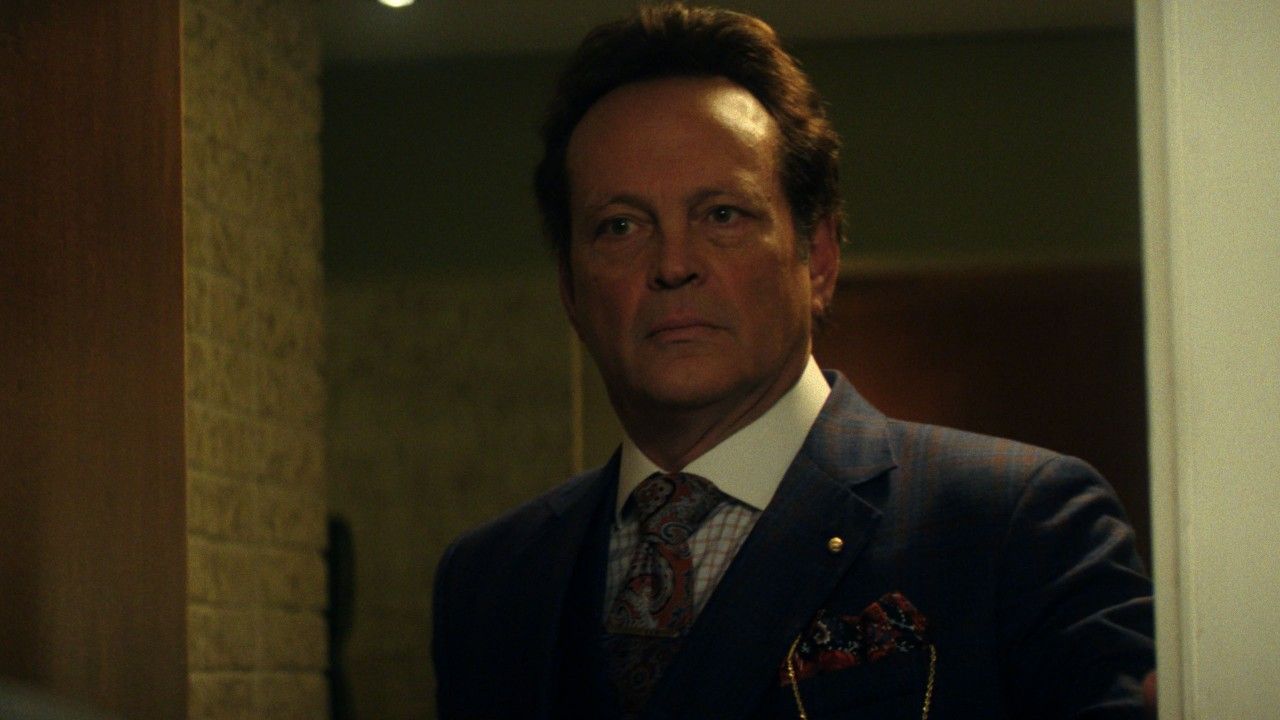

Major spoilers for Mike & Nick & Nick & Alice lie ahead, so read on at your own discretion.
Those who enjoy great time travel movies should do themselves a favor and watch Mike & Nick & Nick & Alice, a recent addition to that subgenre of film. Written and directed by BenDavid Grabinski, the 2026 movie schedule entry is an action-packed romp that centers on two longtime friends/mob associates, who embark on a violent adventure that could have life-altering consequences. That all culminates in a truly wild (and satisfying) ending, and Grabinski recently spoke to CinemaBlend about how he sought to craft that conclusion.
Grabinski’s film centers on mob enforcer Nick, who uses a time machine to travel back several months to prevent the murder of good friend Mike (who Nick framed for having an affair with his wife, Alice). Along with the present-day Nick, the group seeks to protect Mike from mob boss Sosa and his adopted son, Jimmy Boy. The third act sees Mike and the Nicks infiltrating Sosa’s home and eliminating him and his forces. Yet the group’s victory is short lived, as Present Nick takes a bullet from a dying Jimmy Boy to protect Mike and Alice.
Within the film, it’s established that whatever happens to Present Nick affects future Nick so, when the former dies while being rushed to the hospital, the Nick of the future vanishes from existence. That’s particularly interesting, though, is that audiences don’t actually see Nick fade (like in beloved film Back to the Future), as he’s simply gone when the camera pans back to his seat in the car. Grabinski told CinemaBlend why he wanted that specific ending and didn’t consider alternatives:
Time travel movies (which can be streamed or rented) can be quite tricky, as the director and writers have to establish ground rules for how it works. After all, time travel in a movie like The Flash differs from the travel dynamics in Indiana Jones 5. There’s also the visual representation of what it looks like if or when someone is erased from a timeline. On that note, Grabinski talked about the small tweaks he made to ensure viewers weren’t left out of sorts:
Additionally, there are other variables that have to be considered as well. BenDavid Grabinski – whose credits also include Happily and Scott Pilgrim Takes Off – also mentioned a cosmetic detail that could also make viewers second guess his film’s ending:
Due to Grabinski and co.’s efforts, the ending hits the right emotional note. (I’m still thinking about watching all of that play out while Oasis’ “Don’t Look Back in Anger” played over the scene.) I’d argue that it’s difficult to hit sentimental beats in any kind of film, and only certain filmmakers have been able to achieve that in a somewhat heightened film like this one. On top of that, Grabinski also sets the stage for a potential sequel, as Alice reveals the existence of another time machine that could help her and Mike save Nick.
Mike & Nick & Nick & Alice’s Crazy Ending Explained: How The Director Made It Less Confusing For Audiences