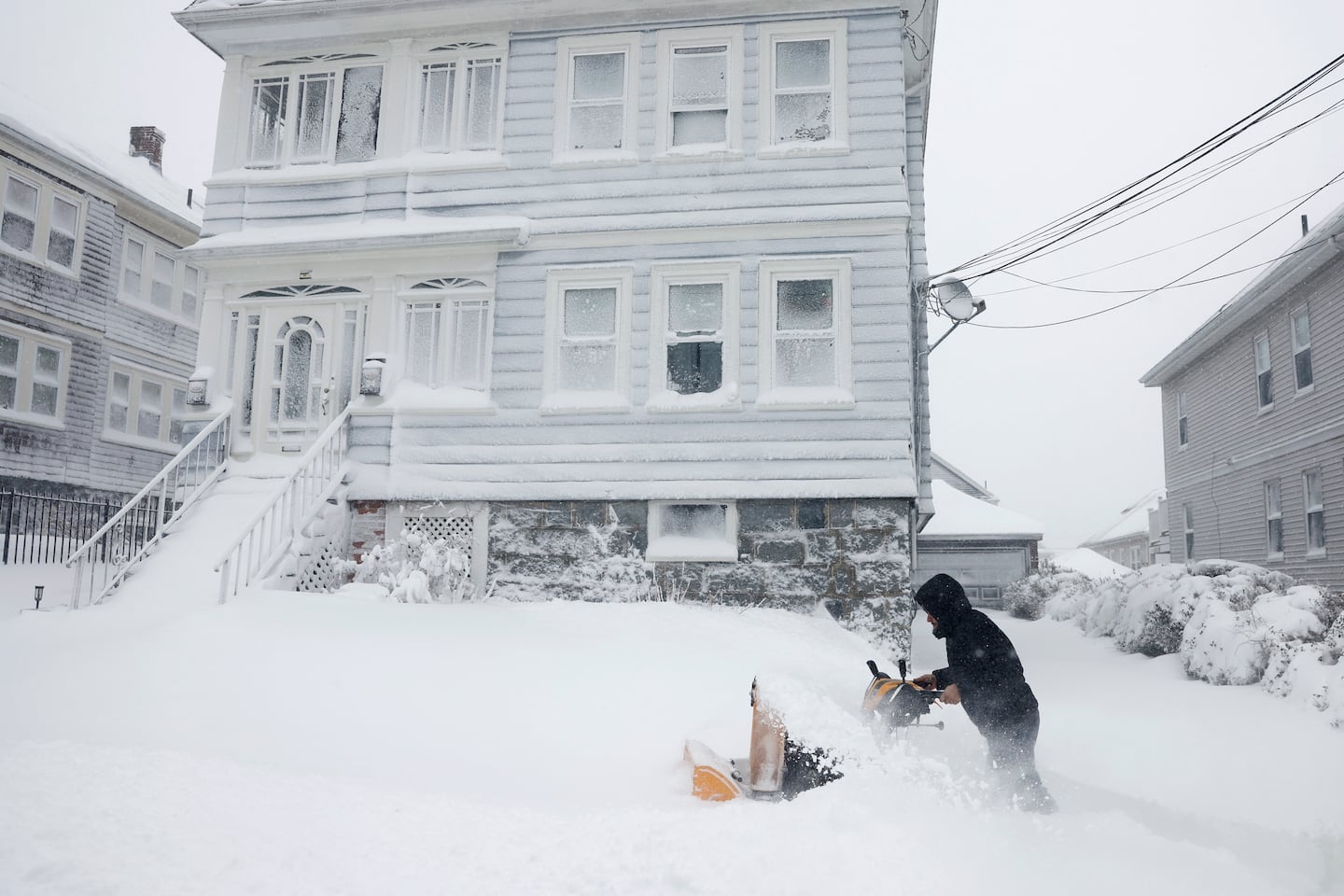

Logan Airport in Boston recorded 16.9 inches, the National Weather Service said Monday night. Some city neighborhoods received higher amounts, officials said.
Dighton, New Bedford, Swansea, and Taunton all reported snow totals of more than two feet from Monday’s nor’easter.
“Thirty inches of snow is no joke, that’s for sure,” said Jonathan Darling, a spokesperson for the city of New Bedford.
Governor Maura Healey issued a travel ban in the four hardest hit counties, Barnstable, Bristol, Dukes, and Plymouth. The MBTA will continue to operate Tuesday with reduced service, officials said.
Dozens of school districts across the state will be closed Tuesday for a second straight day, as communities start to dig out.
“This storm has been a doozy,” said Healey during an afternoon press conference.
As of Monday evening, there were still more than 272,300 power outages in Massachusetts. And with winds slow to die down, power restoration efforts could not immediately begin, officials said.
Residents could be facing a “multiday power restoration,” and state officials asked for the public to be patient. The main issue for getting the power back will be access for utility crews, they said. The winds need to abate in some parts of New England for crews in bucket trucks to safely reach downed lines, and the roads have to be clear for crews to get to problem areas, according to authorities.
In Scituate, residents were told to brace for multiple days without power. “Things are a mess,” said Town Administrator James Boudreau.
The storm also hit Rhode Island hard, breaking records there set by the Blizzard of ‘78. By 8 p.m., the T.F. Green Airport had reached 37.9 inches.
The storm paralyzed road travel, and grounded hundreds of local flights. It lashed coastal areas, with some towns on Cape Cod and the Islands recording winds topping 70 miles per hour. Nantucket was blasted by a 78-mph wind gust, the strength of a Category 1 hurricane, shortly after 10:30 a.m.
Globe meteorologist Ken Mahan said the nor’easter accelerated on Sunday night into a bomb cyclone, meaning it underwent what we call “bombogenesis,” in which it technically “bombed out,” with its central pressure dropping 24 millibars or greater within 24 hours.
The snow fell heavily for hours while high winds whipped through the region, and the gnarly conditions prompted Healey to issue a ban on non-essential vehicle travel in a huge section of Southeastern Massachusetts, because of dangerous road conditions.
Downed power lines, felled trees, and abandoned and stuck cars complicated the state’s response to the storm, state officials said. State Police reported responding to more than 400 disabled vehicles on the state’s roadways through Monday afternoon. Those caught violating the travel ban could face a $500 fine, according to officials.
The National Guard deployed personnel and equipment to Duxbury and Pembroke to assist with snow removal and emergency services calls, according to the towns’ fire departments.
At one point, utility companies reported more than 350,000 customers without power Monday across Eastern Massachusetts, Rhode Island, and Connecticut. A handful of emergency shelters were opened in the areas hardest hit by power outages, including Plymouth, Cape Cod, and Rhode Island. Seventeen warming stations were also opened in Eastern Massachusetts.
Residents appeared to heed officials’ calls to stay off the roads. Downtown Boston was a relative ghost town Monday, but South Station was open overnight to allow people to shelter there as an “emergency option only,” according to an MBTA spokesperson.
During the Jan. 25 snowstorm, the state came under fire for not allowing dozens of homeless people to remain overnight at South Station as two feet of snow fell in Boston. Many people instead had to find their way to the nearby South Station bus terminal where they were allowed inside even if they did not have a bus ticket.
Transportation officials in the state redeployed equipment to the South Coast to help cities and towns there deal with the snowfall. According to officials, motorists “should expect a reduced level of service on highways statewide for a prolonged period.”
Officials in Massachusetts also restricted truck travel on interstate highways until further notice, and reduced the speed limit on the Massachusetts Turnpike to 40 miles per hour.
At Boston’s Logan International Airport, more than 970 flights were grounded because of the storm. The MBTA’s buses, subway, and commuter rail operated on a reduced schedule, something that would continue into Tuesday, officials said. Ferry service was canceled. Amtrak also canceled dozens of scheduled train trips in the region on Monday.
And other aspects of New England’s day-to-day ground to a halt. Some Dunkin’s, the ubiquitous coffee chain as synonymous with Greater Boston as clam chowder and nonrhotic accents, shut down. Market Basket, the grocery chain with a cult-like following, closed all of its Massachusetts locations at noon. Food delivery apps announced moratoriums.
Quality Mart in Boston’s Back Bay is apparently made of tougher stuff. The corner store stayed open, selling some staples — eggs, milk, and bread — during the brunt of the storm.
“We do it for the neighbors,” said Chafik Hamadeh, general manager of the store at 21 Massachusetts Ave. “People depend on us, so we make sure we get here and we open for them, and anything they need is available.”
To reach blizzard status, a storm must have whiteout conditions with visibility of a quarter-mile or less for at least three consecutive hours as a result of snow along with winds of at least 35 miles per hour. Multiple localities hit that mark on Monday, including Boston, Worcester, Providence, and the Cape and Islands.
In Winthrop, multiple water main breaks Monday, caused by power outages at the pressure relief valve stations, resulted in flooding and the town’s Department of Public Works briefly shutting down water service townwide.
A large tree toppled onto a house in Wellesley Monday morning, police said, but no injuries were reported. In Boston, the city had no reports of flooding but did receive a couple dozen calls for downed trees, officials said.
Local officials in Massachusetts encouraged people to stay off the roads, as the heavy, wet snow and winds created whiteout conditions. They are asking the same for Tuesday, as more people out and about could complicate snow removal efforts and emergency responses, according to authorities.
“We need everyone to continue to stay home because going out can make things more difficult and dangerous,” said Boston Mayor Michelle Wu during a news conference late Monday afternoon.
The snow emergency parking ban will continue in Boston until at least 6 p.m. Tuesday, as crews will work to widen passable parts of thoroughfares to the curb, officials said.
Jaime Moore-Carrillo, Nick Stoico, Shirley Leung, Jenna Perlman, and Emily Sweeney of Globe staff and Globe correspondents Hannah Gokee and Adam Sennott contributed.
Monster storm hammers southern New England with high winds and more than two feet of snow