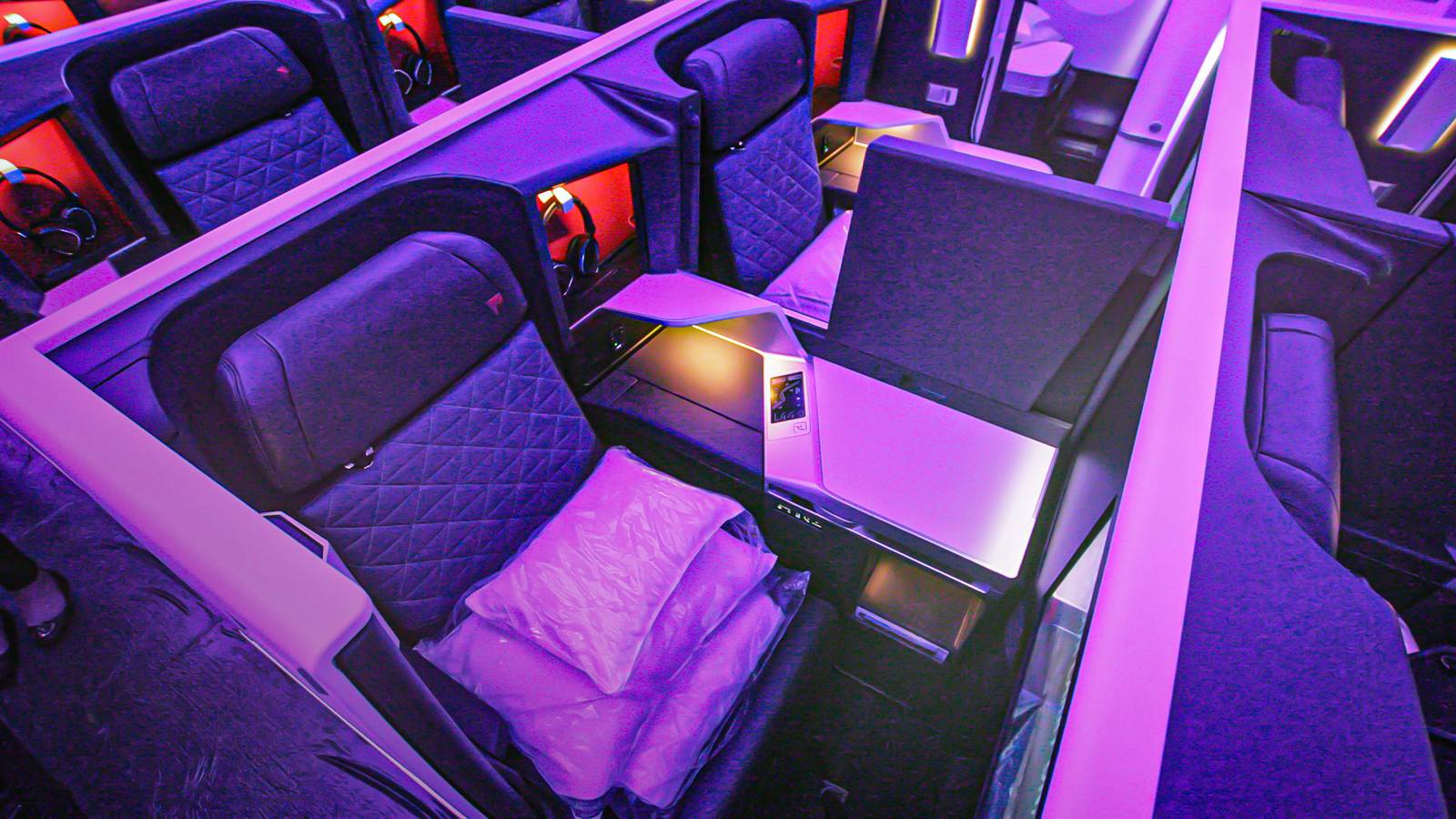

Delta One and United Polaris represent the pinnacle of premium long-haul travel offered by US airlines, and the gap between these flagship cabins and standard business class has never been wider. As airlines increasingly compete on experience rather than just price or schedule, the quality of premium cabins has become a defining factor in passenger choice. This guide breaks down how Delta One and United Polaris compare across seating, service, lounges, and overall passenger experience. Which of these two products stands out the most?
While both products aim to deliver a true international business class experience, they reflect very different philosophies from Delta Air Lines and United Airlines. From suite design and dining to ground experience and route deployment, the differences between Delta One and United Polaris go far beyond branding. Understanding those differences helps travelers make more informed decisions when choosing between the two on long-haul routes.
How Delta One & United Polaris Define Premium Travel
Delta One and United Polaris are both positioned as true international business class products, designed around lie-flat seating, premium dining, and priority airport services. Each airline markets its product as a seamless premium journey from terminal to cabin, not just a better seat onboard. Both airlines have delivered on the needs of all business class travelers by meticulously crafting a complete experience for everyone. However, the way that promise is delivered differs significantly between the two carriers.
Delta One places heavy emphasis on luxury branding and consistency, with its suite-based product rolling out across Airbus A350s, Airbus A330-900neos, and select Boeing 767-400 aircraft. United Polaris, meanwhile, focuses on fleet-wide standardization, ensuring that nearly every long-haul widebody aircraft offers the same seat design and onboard experience. Both approaches have their own strengths, depending on whether a passenger values uniformity or cutting-edge cabin design.
At a strategic level, Delta positions Delta One within a broader premium ecosystem that includes exclusive Delta One Lounges and premium check-in facilities. United Polaris follows a similar path but places greater emphasis on its Polaris Lounges and the ability to deliver a consistent experience across a very large international network.
Seat Design, Privacy & Cabin Layout
Seat design is where the most visible differences between Delta One and United Polaris emerge. Delta One’s newest suites feature full-height sliding doors, creating one of the most private business class environments available on US carriers. These suites are arranged in a 1-2-1 configuration, with every passenger enjoying direct aisle access and a defined personal space. The product represents a significant upgrade from economy, offering a completely different experience for passengers.
United Polaris also uses a 1-2-1 layout across most of its widebody fleet, but privacy is achieved through staggered seating and angled partitions rather than doors. While this still offers excellent privacy compared to older business class products, it does not provide the same enclosed feel as Delta One Suites. On some older Boeing 777-200 aircraft, Polaris branding may still appear on aircraft without the latest seat generation, creating occasional inconsistency.
In terms of comfort, both seats convert into fully lie-flat beds and offer high-quality bedding. Delta’s partnership with Missoni for amenity kits and bedding adds a distinct luxury touch, while United Polaris partners with Saks Fifth Avenue for its sleep sets. Seat width and pitch vary slightly by aircraft type on both airlines, but overall comfort levels are broadly comparable for most passengers. Ultimately, it doesn’t matter too much which product you choose; comfort is guaranteed regardless.
Dining, Amenities & Inflight Service
Dining has become a major battleground for premium cabins across the world. It serves as a chance for airlines to take great leaps forward in passenger experience. For many passengers, food is one of the biggest factors in deciding which premium product to choose. Delta One is no exception to this trend, having invested heavily in chef partnerships and curated menus. Collaborations with chefs such as José Andrés and premium champagne brands like Taittinger help position Delta One as a true restaurant-style experience in the sky. Meal presentation and plating are key parts of the Delta One brand identity, ensuring that every dish is to the highest standard possible.
United Polaris focuses more on flexibility and functionality, offering multi-course meals with options like express dining for passengers who prefer to maximize sleep time. The return of the Polaris ice cream sundae cart has been particularly well received by frequent flyers. While United’s catering quality can vary by route and departure station, the airline has steadily improved consistency in recent years. While maybe not as classy as Delta One, United Polaris provides more choices for passengers, especially those who don’t need a particularly extravagant meal and prefer to take the time to rest.
Amenity kits also reflect each airline’s priorities. Delta One emphasizes sustainability, using recycled materials and eco-conscious packaging. United Polaris kits, developed with Therabody or Sunday Riley depending on route, focus on wellness and recovery. Both products deliver a genuinely premium inflight service, though Delta’s approach feels more luxury-driven while United’s leans practical and sleep-focused.
Ground Experience & Lounge Access
The ground experience is increasingly where premium airlines differentiate themselves, and Delta has made significant moves with the introduction of dedicated Delta One Lounges. These lounges, currently available at airports such as JFK, LAX, BOS, and SEA, offer restaurant-style dining, wellness facilities, and spaces designed specifically for Delta One passengers rather than elite status holders. This serves as a contrast to many other airlines, which tend to offer such exclusivity to first class passengers rather than to business class.
United Polaris Lounges were among the first truly premium business class lounges in the US market and remain a strong selling point. Located at major hubs including Newark, Chicago O’Hare, Houston, San Francisco, and Washington Dulles, Polaris Lounges feature à la carte dining, shower suites, and quiet rest areas. Access policies are stricter than standard United Clubs, reinforcing their premium positioning.
Beyond amenities and design, lounge access also plays an increasingly strategic role in how airlines differentiate premium cabins. Delta’s decision to create standalone Delta One Lounges signals a shift toward treating ground experience as an extension of the cabin itself, effectively blurring the line between airport and aircraft. United, meanwhile, has taken a more network-driven approach, prioritizing Polaris Lounge availability at major hubs to ensure consistent access across its long-haul operation. For frequent flyers, this difference matters: Delta One delivers a more exclusive, curated experience on select routes, while United Polaris offers broader, more predictable lounge coverage across a global network.
Routes, Aircraft & Network Strategy
Delta One is primarily deployed on long-haul international routes and select premium domestic services, often using Airbus A350 and A330-900 aircraft. Delta has also expanded Delta One onto high-demand transcontinental routes, positioning the product as a flagship offering even on domestic flights. However, the availability of Delta One Suites can vary by aircraft and route.
United Polaris benefits from United’s vast international network and standardized widebody fleet. Polaris-equipped aircraft operate on most transatlantic and transpacific routes, as well as select premium transcontinental services. This widespread deployment makes it easier for travelers to reliably find Polaris on long-haul United flights compared to Delta One Suites.
From a network perspective, Delta prioritizes premium-heavy routes and joint venture hubs, while United leverages scale and frequency. Neither approach is inherently superior, but each aligns with the airline’s broader strategy and target customer base.
Which Product Is Better For Travelers?
Choosing between Delta One and United Polaris ultimately depends on what a traveler values most. Delta One offers a more luxurious and design-forward experience, particularly on aircraft equipped with the latest suites and when paired with access to Delta One Lounges. For passengers who prioritize privacy, aesthetics, and premium branding, Delta One often has the edge.
United Polaris excels in consistency and network reliability. Travelers flying long-haul routes across multiple continents are more likely to encounter a standardized Polaris experience regardless of aircraft type or departure city. The Polaris Lounge network also remains one of the strongest premium ground offerings among US airlines.
Looking ahead, both airlines continue to invest heavily in their flagship cabins, suggesting the gap between Delta One and United Polaris will keep evolving. As competition intensifies, passengers stand to benefit from continued innovation across both products.
The Striking Differences Between Delta One & United Polaris