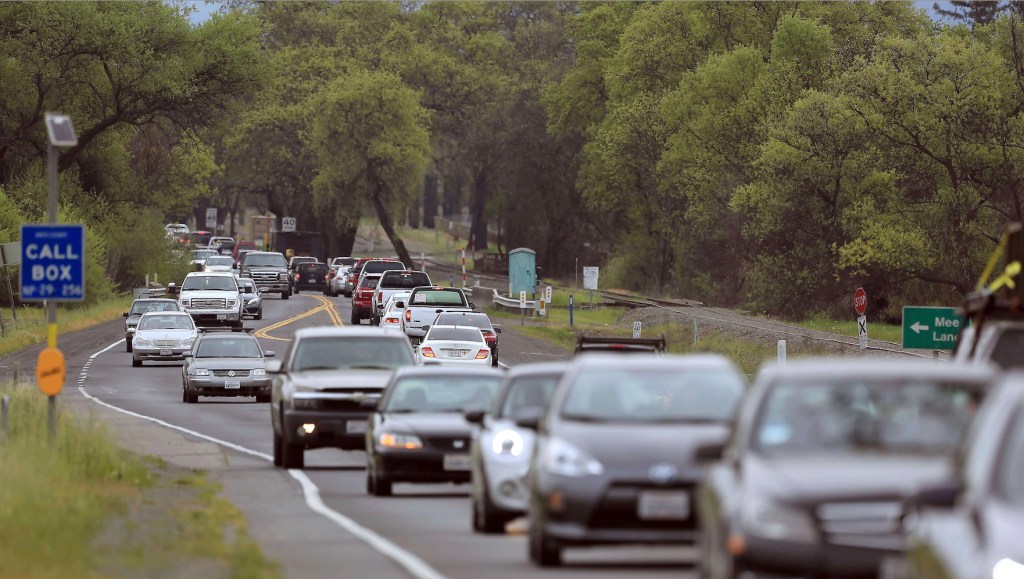

Napa County traffic has mostly returned to pre-pandemic levels, but the way people move around the county has shifted significantly — driven largely a surge in remote work — according to a new study commissioned by the Napa Valley Transportation Authority.
The 2025 Napa Valley Travel Behavior Study, which analyzed travel patterns in fall 2024 and builds on similar studies from 2014 and 2020, found that while the county now generates roughly the same number of daily trips as in 2018, residents and workers are traveling differently.
Daily work trips declined from 106,000 in 2018 to 101,000 in 2024 — a 5% drop that reflects a smaller local workforce and fewer people commuting every day. The biggest change came from Napa County residents who work outside the county: that group shrank by 19%, or 5,000 trips. The number of workers commuting into Napa also fell by 6%, or 2,000 people. Meanwhile, internal work trips grew slightly, up 2% or about 1,000 trips.
Remote work has reshaped the landscape even more. In 2018, about 3,700 Napa County residents worked from home. By 2024, that number more than doubled to 8,200 people.
Despite these shifts, the county produced nearly identical numbers of overall daily trips — 417,000 in 2018 compared to 418,000 in 2024 — NVTA Executive Director Danielle Schmitz said at the agency’s Nov. 19 board meeting. What changed, she said, is when and how residents travel.
Pass-through traffic rose 10% over the six-year period, and internal trips increased by 5%. Visits to Bel Aire Plaza surged 23%, indicating more local, discretionary daytime travel. By contrast, inter-county trips dropped 12%, and both average trip length and total vehicle miles traveled fell by 9%.
Schmitz said the county’s commute patterns have become more elongated, with residents making more trips throughout the day rather than clustering them around traditional morning and evening peaks. That creates new questions about how NVTA should invest in its transit network, particularly because the findings challenge long-held assumptions that commuter-focused services should be the agency’s priority.
“Where we are seeing a lot of transit trips is on our countywide regional service, our 10 and 11, that just go up and down the Valley,” Schmitz said. “And that is our bread and butter service for our transit system.”
Remote work reshapes Napa travel patterns even as traffic returns to pre-pandemic levels