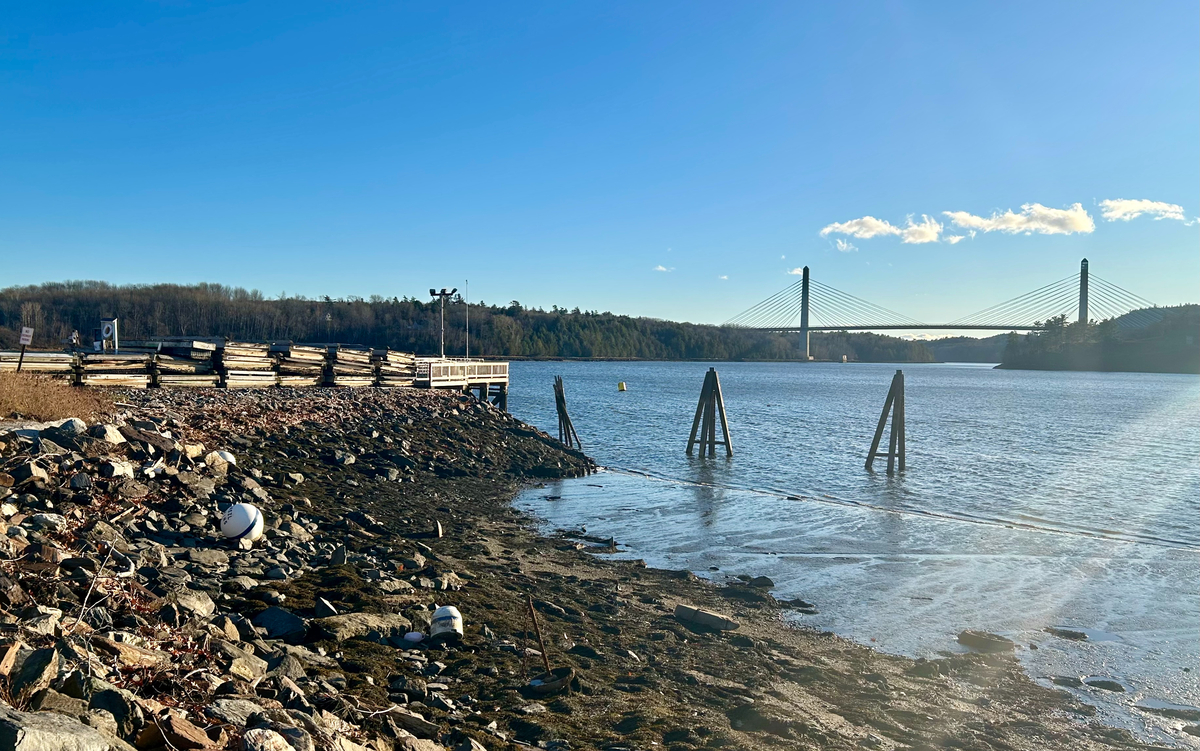

Bucksport’s public dock is on track for a $4.1 million overhaul next year to make it usable year-round and more accessible for increasing numbers of boaters and cruise ships.
Once a small dock for fishermen, the town started the process of overhauling it into a 315-foot seasonal float system in the early 2010s as concern grew over mercury contamination from the HoltraChem plant upstream. The state permanently closed the Penobscot River estuary to commercial fishing because of the mercury in 2014.
For years, the town has been working on a plan to change the dock again, this time into a 400-foot, year-round concrete-surfaced float with a wider, ADA-compliant gangway and three-phase power to supply cruise ships. The project is fully covered by federal funding and was expected to go out to bid earlier this year, but was delayed to make sure it wouldn’t harm endangered species of fish and, later, by the government shutdown.
Now in the final stages of a federal review, it’s on track to go out to bid next year and be completed by spring 2027, according to Rich Rotella, the town’s economic development director.
The upgrades represent a new phase in the life of the town’s waterfront, coming as Bucksport has increased its recreational boat traffic and cruise ship visits dramatically in the last year. Increasing activity on the river is part of the town’s multi-pronged approach to diversifying its economy since the closure of its paper mill more than a decade ago.
The town dock was originally built for the area’s fishermen and lobstermen in the 1970s, according to Rotella. The town had to find a new use for it as fishing declined, and built the current 315-foot seasonal dock to accommodate more pleasure boaters.
Meanwhile, Bucksport started courting cruise ships soon after the 2014 closure of the Verso Paper mill, and one made its first planned visit in 2018. Town officials said at the time that though Bucksport was less commercialized for tourists than other ports, it had a “down home vibe” they could capitalize on.
The town signed a 15-year agreement this summer giving priority docking rights to American Cruise Lines, the company leading those visits, with an option to extend it for another five years.
Between six to 10 ships visited annually in recent years, according to Rotella, a number that jumped to 28 this season. Twenty requests are already in for next year, including three American Cruise Lines ships that have never visited the town before, he said.
Cruise ship traffic has become contentious in Maine’s two biggest cruising ports, Bar Harbor and Portland. This summer, the number of ships visiting Bar Harbor plummeted after Bar Harbor residents voted to essentially ban large ships. Smaller ships such as those operated by American Cruise Lines are not affected by the Bar Harbor ban.
At the same time, other ports such as Bucksport and Eastport have sought to boost their cruise ship numbers. But the increased number of ships visiting Bucksport aren’t likely a result of larger ones being pushed out elsewhere, Rotella said, as taller vessels can’t fit under the Penobscot Narrows Bridge.
Previously, Bucksport was primarily a stop for visitors to board charter buses to Bar Harbor. But this year American Cruise Lines started offering a daystop focused specifically on Bucksport and neighboring towns, with passengers being directed to Fort Knox, the Penobscot Narrows Observatory, Main Street and other local attractions. Bucksport’s historical society has noted a measured increase in attendance from ship visitors.
“Here, we’ve really made ourselves a destination,” Rotella said. “It really has made a positive impact, especially compared to what it used to be.”
The number of private pleasure boaters are also increasing, he said; the town has promoted itself as a stop along the way for boaters traveling to Bangor from Belfast or Castine.
The next step in permitting the new dock is a public comment period on a review of the project by the U.S. Department of Housing and Urban Development, which opened Monday and will close after Dec. 9.
After permit approval following that, the project can go out to bid, according to Rotella. Another $825,000 from a trust created out of a settlement with HoltraChem’s successor will help fund the three-phase power and a public water line extension for fire protection and freshwater supplies for ships.
“They’re currently getting water out of a garden hose,” he said.
Though the work isn’t out to bid yet, prospective bidders are already contacting the town, he said.
“There’s interest in the project, which is great,” he said.
Bucksport investing $4.1M in dock to accommodate cruise ships