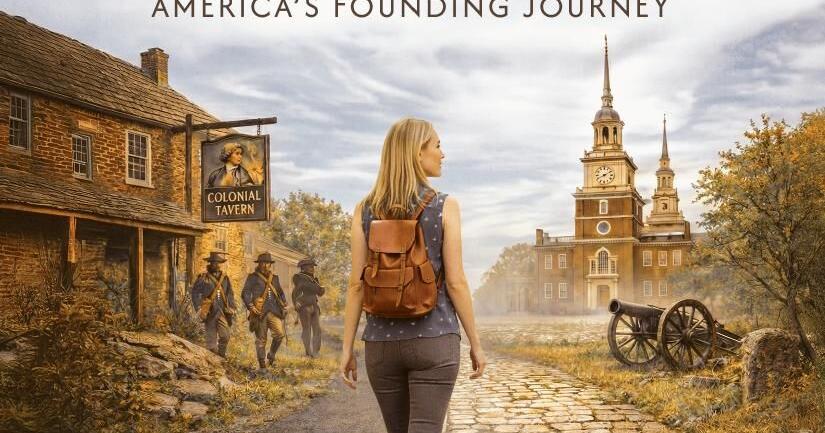

South Carolina native Darley Newman crisscrosses the globe for her popular PBS television show, Travels with Darley, a series that appeals to outdoors enthusiasts, history buffs and road trippers. Newman recently visited Charleston with her new book, Revolutionary Road Trip: Hidden Stories of America’s Founding Journey. It features two chapters on South Carolina. Her unique path to her dream job includes jobs as a teenage Myrtle Beach camerawoman, interviewing death row inmates for CBS and filming a heart surgery by Dr. Mehmet Oz.
Her new dream project? A multimedia travel guide to crucial, yet lesser known, Civil Rights sites.
The following interview has been edited for length.
What launched your career?
When I was a kid, I got a video camera for Christmas. I made my family and neighbors be in talent shows I filmed. One friend insisted she had no talent. … I gave her the gypsy dress my aunt bought in Europe and told her to be a fortuneteller. (Laughing) I had self-confidence.
When I was 15, I was hired as camerawoman to film local government meetings. … It was a big deal because I got paid.
While I was in George Washington University, I covered the Clinton White House for radio. (groans then laughs) I felt like a fish out of water because I wasn’t into politics. I’m still not. … Radio show hosts would question me and I thought, this is going to be a challenge because I don’t know what’s happening.
I did lots of jobs where I would say OK, I can learn to do this. I had no clue. But I would jump in like, sure, I’ll tackle that. I’ve heard entrepreneurs say: if someone offers you an opportunity, take it and figure it out.
What was your first job after college?
I worked for CW (network) programming baseball games and movies. To be honest, it was boring. I lived in Foggy Bottom and used to ride my bike up this big hill in Georgetown to get to work. I arrived all sweaty. I had a whole routine because there wasn’t enough work to fill my day. I would go to Whole Foods, get a muffin, come back, make tea. …
I had enough time to write two different books there that I never published. Everyone would say: Darley’s always so busy all the time. I was voted Employee of the Year. They were really nice.
Newman next worked for PBS Frontline documentary producer Sherry Jones in Washington, D.C.
After a year, I moved to New York. D.C. is focused on politics, lawyers, lobbyists. … I was interested in more topics. … I couldn’t stay in a small, quiet office. … I’m still in New York now.
Did you have a job lined up there?
No, but I got a job very quickly. I was lucky.
A colleague recommended Newman to legendary producer Susan Zirinsky, who became the first woman to serve as CBS News president. Zirinsky is the model for the brainy, determined heroine (played by Holly Hunter) in the iconic comedy film Broadcast News.
Susan was a mentor to me. I learned a lot. I was hired as a 48 Hours production secretary, what today they would call a production assistant. Isn’t that weird? I bet the production secretary title isn’t used now.
They sent me to interview people, lawyers, people who committed crimes.
By phone, I interviewed a death row inmate. Then they didn’t do the story. He kept calling me. … I felt so badly. I’d tell him, it’s out of my hands. I can’t help.
Did you get to see stories to fruition after interviews?
Not really. The process was very segmented. … Some interviews involved life and death. It was inspiring because if you told the true story well, you could change someone’s life for the better. But not everyone gets a chance to be on the show. I was sad for them. In the end, I didn’t love that job because of that negative.
Before producing her Emmy-winning Equitrekking series for PBS in 2007, Newman freelanced and filmed many medical documentaries.
I don’t like blood. I filmed Dr. Mehmet Oz doing open-heart surgery I thought I might faint … Remember the Seinfeld episode where (Kramer) drops a Junior Mint into a patient on an operating table? I was afraid I might drop this camera into the patient … But it went fine.
What Travels with Darley episodes make you proudest?
I like to tell good stories, share insights into different cultures. I don’t mind asking for what we need because I feel the program is a public service. It’s educational, involves living history. More of that should be out there.
We ask for and get amazing access. In New Mexico, we filmed with the Mescalero Apaches. …South Carolina’s Lisa Collins (administrator of the Wassamasaw Tribe of Varnertown Indians) has been cataloguing her tribe’s role in the Revolutionary War. She’s in the show and book.
Historian Rick Wise, a combat veteran, walked me through the Battle of Camden on camera. His military experience gave that episode an emotional depth. Gullah Tours owner Alfonso Brown told us about Gullah and Geechee culture, including the cuisine.
Wherever you go, locals introduce you to delicious food. How do you stay slim?
I have backup eaters! I share food with my crew and my researchers.
There’s a lawsuit against the U.S. Interior Department over its order for national parks to remove exhibits and signage pertaining to Black History and slavery. Do DEI debates create obstacles to telling compelling Black history?
Park rangers and historic societies are great sources for me. … Viewers connect with Black history stories. … One of my living history Civil Rights interviews is viral on TikTok, one million viewers in one week for (Mississippi Civil Rights Museum volunteer) Hezekiah Watkins. His story is crazy and true. He was sent to Parchman Prison’s Death Row at age 13 for being a Freedom Rider. Listen. (She opens her phone)
Watkins’ rich voice recounts going to the bus station to see Blacks and Whites protest segregated commercial buses by riding North to South together despite being beaten by mobs. Endless red hearts float past Watkins as viewers click LIKE.
The response is so positive. People are happy to hear his story. … When he was first arrested, he wasn’t a Freedom Rider. Someone pushed him into the bus station. He was arrested 109 more times for protesting.
An accidental activist.
Exactly. For the past few years, I’ve been very interested in interviewing people who lived through historic moments. I love it. … It’s urgent to record these folks while they’re still with us.
Any advice for folks wanting to explore history and cultures but can’t afford travel?
Don’t overlook gems in your neighborhoods. (She looks around bustling Sorelle Mercato). This place where we’re having coffee may have a great story.
The space at 88-90 Broad St. was built in the 1730s. It has been a tenement, an apothecary, a tavern and the Hebrew Society’s charitable orphanage.
We’re only on this planet one time. It’s important we share with each other, learn each other’s stories. You’ll be a happier person if you do.
Darley Newman talks new Rev War book, television career