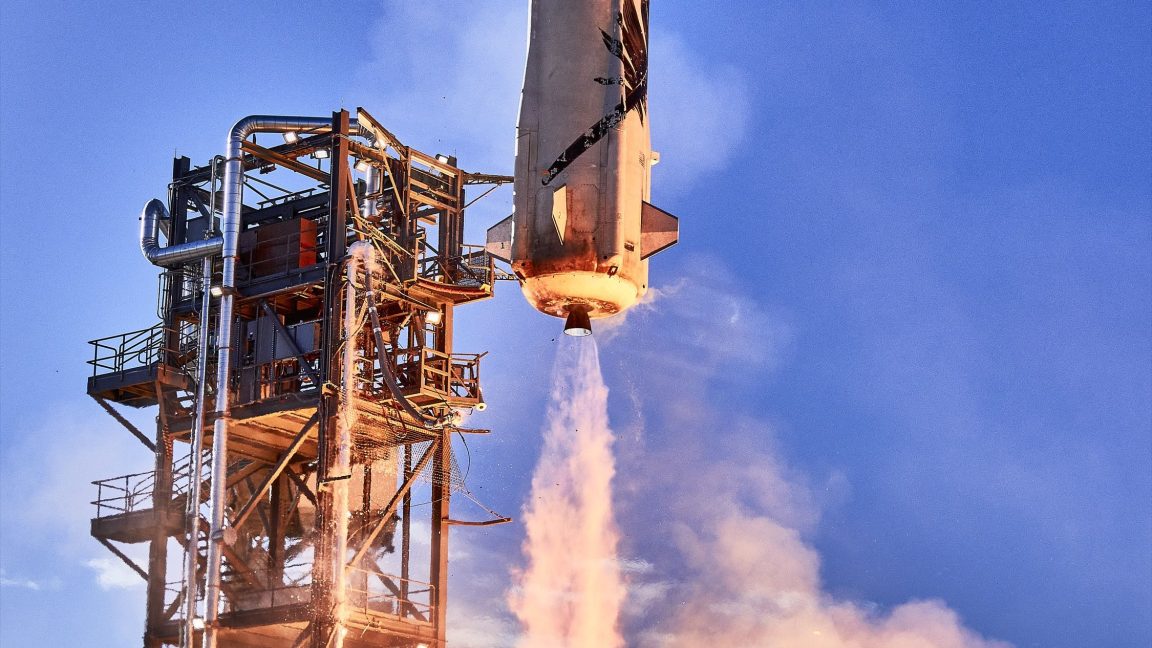

Blue Origin has “paused” its New Shepard program for the next two years, a move that likely signals a permanent end to the suborbital space tourism initiative.
The small rocket and capsule have been flying since April 2015 and have combined to make 38 launches, all but one of which were successful, and 36 landings. In its existence, the New Shepard program flew 98 people to space, however briefly, and launched more than 200 scientific and research payloads into the microgravity environment.
So why is Blue Origin, founded by Jeff Bezos more than a quarter of a century ago, ending the company’s longest-running program?
“We will redirect our people and resources toward further acceleration of our human lunar capabilities inclusive of New Glenn,” wrote the company’s chief executive, Dave Limp, in an internal email on Friday afternoon. “We have an extraordinary opportunity to be a part of our nation’s goal of returning to the Moon and establishing a permanent, sustained lunar presence.”
Move was a surprise
The cancellation came, generally, as a surprise to Blue Origin employees. The company flew its most recent mission eight days ago, launching six people into space. Moreover, the company has four new boosters in various stages of development as well as two new capsules under construction. Blue Origin has been selling human flights for more than a year and is still commanding a per-seat price of approximately $1 million based on recent sales. It was talking about expansion to new spaceports in September.
Still, there have always been questions about the program’s viability. In November 2023, Ars published an article asking how long Bezos would continue to subsidize the New Shepard program, which at the time was “hemorrhaging” money. Sources indicate the program has gotten closer to breaking even, but it remains a drain on Blue Origin’s efforts.
About 400 people spend part or all of their time working on New Shepard, but it also draws on other resources within the company. Although it is a small fraction of the company’s overall workforce, it is nonetheless a distraction from the company’s long-term ambitions to build settlements in space where millions of people will live, work, and help move industrial activity off Earth and into orbit.
In a company-wide email on Friday, Phil Joyce, senior vice president for New Shepard at Blue Origin, said the team has safely flown many people to space and proven technologies used to land the New Glenn rocket. “This program has laid the groundwork for our company’s future success,” he wrote. “We should all be proud of what we’ve accomplished together.”
Limp said the company would support its employees in finding other roles at the company, “particularly within Lunar and New Glenn.” This underscores that this decision, almost certainly made by Bezos, is intended to accelerate the company’s efforts to fly New Glenn more frequently and deliver on its cargo and crew lunar landers.
Ultimately, this is good for NASA
This certainly dovetails with NASA’s priorities, as it is counting on Blue Origin to compete with SpaceX for contracts to land humans on the Moon as part of the Artemis Program.
Multiple industry sources on Friday afternoon expressed both regret and appreciation for the decision to move on from New Shepard. The program offered a safe way to fly humans into space, with minimal training. The dozens of people who flew experienced an amazing 10 minutes: launch, ascent, weightlessness, a grand view of Earth, and a return to the planet; almost all were in awe afterward.
However, the flights of Bezos and other prominent people, notably Katy Perry, opened up Blue Origin and the broader commercial space industry to the criticism that spaceflight was just a plaything for billionaires, celebrities, and their toys.
The decision to end New Shepard will inconvenience a few dozen very rich people waiting their turn to go into space on New Shepard, but more broadly, it is a win for the US space industry. Blue Origin has justifiably been criticized for trying to do too many things at once, resulting in all of its programs moving too slowly. Focusing on New Glenn and the lunar lander program in the near term will be a great boon for space access and the nation’s competition with China to secure the Moon.
Here’s why Blue Origin just ended its suborbital space tourism program