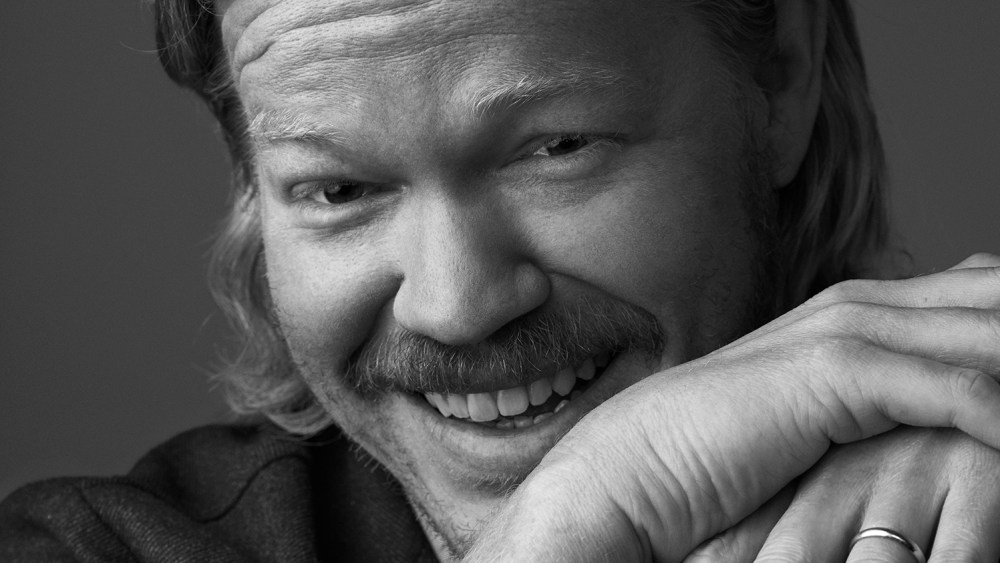

The first thing you need to know about Jesse Plemons is that he’s planning a purge. Not the horror movie kind — no sirens, no sanctioned chaos. Something quieter, more domestic: five full days blocked off to clean out his garage.
“We moved into this house six years ago, and we never had that moment of purging all of the stuff we don’t need,” Plemons says, laughing at the absurdity of explaining home organization while promoting what many consider the best performance of his career in Yorgos Lanthimos’ “Bugonia.” “The time is right.”
It’s an almost too-perfect metaphor — clearing space, seeing the walls again, stripping away what’s accumulated quietly over time. It’s the kind of detail that could live inside a Lanthimos film, the mundane brushing up against something existential, the ordinary revealing deeper anxieties about control and chaos.
When Plemons learned he’d earned his second consecutive Golden Globe nomination — this time for “Bugonia” — he wasn’t celebrating. He was making school lunches and strategizing elf-on-the-shelf placement. His wife, actress Kirsten Dunst (who both received their first Oscar nominations on the same film, “The Power of the Dog”), was out of town. Their two kids needed to get to school.
“I woke up to a ton of texts,” the actor says, settled on a couch at Variety’s Los Angeles offices, and visibly uncomfortable with attention. “But then immediately it’s like, my kids don’t care about that, and they got to get to school.”
That grounding — the ability to move seamlessly between awards-season attention and domestic routine — has long defined Plemons.
Born in Dallas and raised in Mart, Texas, he began acting by accident, appearing when he was 2 years old in a rodeo commercial, “just being fed Coca-Cola” while adults chugged the beverage around him, feeling like he was “stepping inside a movie.” He never lost that sense of wonder.
Nor did he ever fully adopt Hollywood’s geography. Plemons still lives primarily in Texas, near family land an hour and a half outside Austin, where his father keeps horses. He and Dunst maintain a place in Los Angeles, but the rhythm remains intentionally split — dipping in and out, refusing full transplantation even as his career has expanded.
Texas was also where everything changed. While filming “Friday Night Lights,” Plemons lived in Austin and accidentally started a band with local musicians who became close friends. He still travels with a guitar, writes songs and imagines an alternate life in music. Music runs through his blood — mostly the ’60s and ’70s: Nina Simone, Townes Van Zandt, Jerry Jeff Walker, Sly and the Family Stone.
“If I wasn’t acting,” he says, “it would definitely be something in the realm of music.”
That openness — to other versions of himself — runs through his work. In “Bugonia,” which premiered at the Venice Film Festival and screened at Telluride, Plemons plays Teddy, a man convinced that unseen systems are manipulating the world. Teddy resembles a familiar contemporary figure: a conspiracy theorist, an institutional skeptic and someone who is certain that truth has been hidden in plain sight.
In less careful hands, the role could have collapsed into caricature. Plemons does something more dangerous, and makes the audience ask: Is Teddy right?
“I didn’t look at it as giving conspiracy theorists a platform,” Plemons shares. “I was thinking more about the world we’re living in, the state of truth and how we communicate with people we don’t agree with.”
He pauses, careful with his words.
“There’s a lot that Teddy is not right about,” he continues. “But there’s something in that feeling — that things are being controlled by forces that don’t care about people — that’s very much in the air right now.”
To prepare, Plemons immersed himself in Naomi Klein’s “Doppelganger,” her dense examination of conspiracy culture and modern information warfare. One idea stuck with him: the notion that many people carry a quiet belief — often suppressed just to function — that systems optimized for profit over humanity don’t have our best interests at heart.
“If you want to find a place to talk about that,” Plemons says, “the majority of your options are these fringe groups that do have a little shred of truth in them. And then once you’re in, it just gets wilder.”
That’s Teddy’s tragedy, and the film’s warning. He’s not a joke. He’s what happens when grievances collide with isolation, and when the only people willing to acknowledge your fear are the ones prepared to exploit it.
For Lanthimos, Plemons was the ideal collaborator.
“He’s very sensitive to all kinds of emotions and triggers,” the director says. “It’s beautiful to see the little things that can make him do something different — a word you tell him, something that changes in the room. He absorbs everything.”
What impresses Lanthimos most is Plemons’ willingness to relinquish control.
“He allows the situation or the other actor to affect him,” Lanthimos says. “That vulnerability and generosity are great qualities for an actor.”
Plemons admits Lanthimos’ rehearsal process initially left him lost.
“The first few days, I was thoroughly confused,” he admits. “Then something shifted. Some sense of abandon took hold, and it became like weird theater camp.”
During one particularly difficult take, Lanthimos offered a note that crystallized everything: “You are not in control. The universe is.”
Plemons says, “It came at exactly the right moment. Everything changed.”
That openness defines his collaboration with Emma Stone, his co-star and producer on “Bugonia,” following their earlier work on Lanthimos’ “Kinds of Kindness.” In the film, written by Will Tracy, Stone’s character studies Teddy, attempting to understand how his mind works, which became a dynamic that allowed the two-time Oscar-winning actress to witness Plemons’ performance with unusual intimacy.
“He cares so deeply about the work, but he’s also a good human being,” Stone says. “Those qualities together are rare. He’s never going to give less than everything he has.”
Unlike actors who arrive with what she calls “an island” — a fixed performance unaffected by others — Plemons remains fluid.
“He moves with you and surprises you,” Stone says. “He puts you on your back foot or disarms you in ways that are genuinely surprising. Sitting there and watching him do so much of this — like a literal captive audience — it was phenomenal.”
One of the film’s most radical choices is the casting of Aiden Delbis, an autistic actor (he prefers the term) making his film debut as Don, Teddy’s cousin and unlikely companion. Don is not written as autistic, but Delbis’ presence reshaped the film’s emotional core.
“When Yorgos told me he was envisioning a nonprofessional actor, potentially someone who was neurodivergent, my initial thought was that it felt like progress,” Plemons shares. “Because the part isn’t written as an autistic person.”
Watching Delbis gain confidence on set remains one of Plemons’ most treasured experiences. His mother worked with special needs children throughout her career, and Plemons says the experience felt personal.
“Yorgos wouldn’t have forced that into being if we hadn’t found Aiden,” Plemons says. “But being who he is, Aiden fits that part in a way no one else could have. I hang out with them all the time. His family comes over, and we cook out and have pool parties.”
Lanthimos dismisses any anxiety the industry might have about accommodating neurodivergent performers.
“It’s being aware of these things,” he asserts. “Films are part of life. Why wouldn’t you be prepared for someone who’s autistic? Jesse was open to that process. He allowed Aiden to change him. That’s beautiful for an actor.”
There are moments when Plemons lights up — sits forward, gets animated — praising his co-stars and the people in his life. When the spotlight swings back to him, he clamps down again.
The comparisons have started to be made: Plemons is a modern-day Philip Seymour Hoffman, the rare actor who can disappear into anything while remaining unmistakably himself. Plemons worked with Hoffman on Paul Thomas Anderson’s “The Master,” three years before his untimely death. He remains uneasy with the analogy.
“It’s flattering,” he says, chuckling nervously. “It feels too much. He’s one of the all-time greats.”
In a coincidence heavy with symbolism, one of Plemons’ next projects is the prequel “The Hunger Games: Sunrise on the Reaping,” where he plays a younger version of Hoffman’s Plutarch Heavensbee.
“It was so much fun,” Plemons says of filming in Berlin alongside Glenn Close and Joseph Zada, before laughing at himself. “I don’t have many interesting things to say, other than it was a really nice experience.”
The self-deprecation, the reflexive deflection of attention, defines Plemons as much as his talent. He’s genuinely uncomfortable with praise, with analysis and with the entire apparatus of celebrity that surrounds the work he loves.
When Laura Dern grabbed his hand at Telluride after seeing “Bugonia” and showered him with overwhelming praise, Plemons remembers that “it almost made me cry.” He also admits his brain “immediately forgot” most of what she said — self-protection kicking in against the weight of admiration.
Another upcoming film sparks more visible excitement: Alejandro González Iñárritu’s “Digger” at Warner Bros., slated for October, which reunites Plemons with Tom Cruise, whom he worked with on “American Made” (2017).
“It’s one of the strangest, funniest, most tragic scripts I’ve read,” Plemons reveals. “There’s a kind of modern-day ‘Dr. Strangelove’ thing, and then it becomes something else entirely.”
He stops short of revealing more, but his admiration is clear.
“Getting to see Tom just go for it — not in a death-defying action way but fully showing what an incredible actor he is — that was thrilling.”
Like many of us, he also loves his work in “Game Night” and is open to more.
“I’d do a ‘Game Night’ sequel in a heartbeat,” Plemons says with a visible grin, calling the 2018 comedy “pure fun.”
Until then, and between films, Plemons returns to his quieter pursuits: music and photography. Stone notes that he’s rarely without a camera. They aren’t hobbies so much as escape routes — ways of being present without performing.
As “Bugonia” travels through awards season, Plemons remains focused on simpler things: the work, his family and those garage walls.
“You really have to find this balance,” he says, “between doing all the work you need to feel ready and then relinquishing all your attachments.”
Back in Texas, five days of purging await. Clearing. Sorting. Making space. And finding out what’s been there all along.
“The time is right,” Plemons says. For the garage. For the role. For whatever strange beast comes next.
The universe, after all, is in control.
Jesse Plemons on ‘Bugonia,’ Tom Cruise and Conspiracy Theories